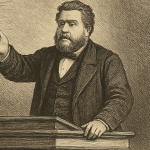
Charles Spurgeon Pulls in the Crowds
I found an article from the British Archive Newspapers which was written in 1857 from The Paisley Herald and Renfrewshire Advertiser titled “Charles Spurgeon and the Pulpit”, it caught my attention not because it goes on about how wonderfully Spurgeon preached and how good his message was, but because it gave a pretty honest look at how people might have viewed Charles Spurgeon based on his physical presentation. The writer seems genuinely amazed and even a bit confused by Spurgeon’s popularity because, well, he didn’t really fit the usual image of what might be classed as a great preacher.
For example, the editor writes:
“Mr. Spurgeon is a notability. He filled Exeter Hall with eager listeners for months together… Professional men, senatorial men, ministers of state, and peers of the realm are among Mr. Spurgeon’s auditory. These are facts that cannot be questioned.”
Why did the editor think these facts should be questioned? I imagine somewhere along the line people have said that his crowds were imagined perhaps. What’s fascinating to me is that the writer openly admits Spurgeon doesn’t have any of the usual “qualifications” you’d expect for someone who packs halls like that. No fancy degrees, no impressive background, and apparently not even a particularly great physical presence:
“He comes direct and openly from what John Foster called ‘the morass of Anabaptism’… His figure is short, and chubby, and rather awkward… His voice, clear and bell-like, lacks richness or tenderness.”
He also went on to say that he had a loud voice that could reach 10,000 but then questioned what it was about him that drew 10,000 in the first place. But the funny thing is, all those “shortcomings” might actually have been exactly why people loved him. He was real. No pretensions, no acting all sophisticated, didn’t particularly dress fancy, he was perhaps just honest and relatable:
“His diction is idiomatic Saxon, plain and direct, understandable to every man or woman… Even when impassioned, he remains natural… He might be a Chartist addressing a crowd in Kensington—such is the absence of pulpit mannerisms.”
And at the end of it all, the writer has to admit the obvious:
“Mr. Spurgeon has made the pulpit more attractive than any living man, not through oratorical excellence but through natural elocution.”
For me, Charles Spurgeon’s story is an important reminder about what really matters when it comes to speaking and influencing others. Sure, there’s a place for polished speeches and fancy words, but Spurgeon shows us something deeper and more lasting, the power of being genuine, straightforward, and sincerely believing in what you’re saying, but as well as that, he clearly had a calling. He was where God had called him to be. We don’t really see many Spurgeon’s about nowadays with the impact he clearly had not only in his time, but even today, but it shows that walking in the calling God has prepared for you brings much fruit!
Even though the article tries to pick at his lack of formal training and polished manners, it actually ends up highlighting how his authenticity and passion were his greatest strengths. Spurgeon managed to cross all the usual boundaries of his day, social classes, education levels, you name it, just by being himself and genuinely being careful to share the message accurately before God. Another article said that he was a man of the bible. Even his letters to his father is a bit like reading Paul writing to the church – I don’t mean he was giving instruction, but more that he was so consumed by the things of God, his letters were more about his relationship with God than what he was up to in his general day to day.
I guess my main takeaways from reading this article was first how surprised I was that the writer did not even mention what Spurgeon preached on, but was more fascinated by his appearance and how he managed to draw so many people to listen to his message, and not just your normal average day to day Joe (like me), but people of stature who were perhaps far more educated than he was. This once again shows that God can use whoever He wants to fulfil His purposes and His ways are far higher than our ways. We don’t have to have a theology degree in order for God to use us to speak to others, we have the Holy Spirit! What on earth more do we need?