The Invisible Weight of Right and Wrong
Imagine watching a video clip recorded on a crowded train platform. A person in a heavy coat deliberately nudges a blind man toward the edge of the tracks, steps back, and watches quietly as the man stumbles. In that exact second, before your mind has time to analyse what you are seeing, something inside you reacts instantly. Your throat tightens, your heart races, and a cold, sharp anger flares in your chest.
It is not an intellectual calculation. It is a physical, visceral recoil. You do not pause to debate whether the person in the coat had a tough morning or whether their background holds a different view on kindness. You know, instantly and without hesitation, that a line has been crossed. That a terrible cruelty has occurred. That it demands a response.
This immediate protest is not unique to extreme moments of cruelty. It hums quietly in the background of everyday life. When a coworker quietly takes credit for months of painstaking labour, or when a stranger steps into a freezing river to pull a child from a sinking car, we recognise something distinct from personal taste. If someone says they prefer bitter coffee while you prefer sweet tea, there is nothing to settle, no wrong to right, and no debt owed. But when fairness is shattered or when selflessness shines, we do not feel we are merely expressing a preference.
We feel the weight of an invisible duty. A conviction that certain ways of treating human beings are binding, real, and demanding of us, regardless of who agrees or disagrees.
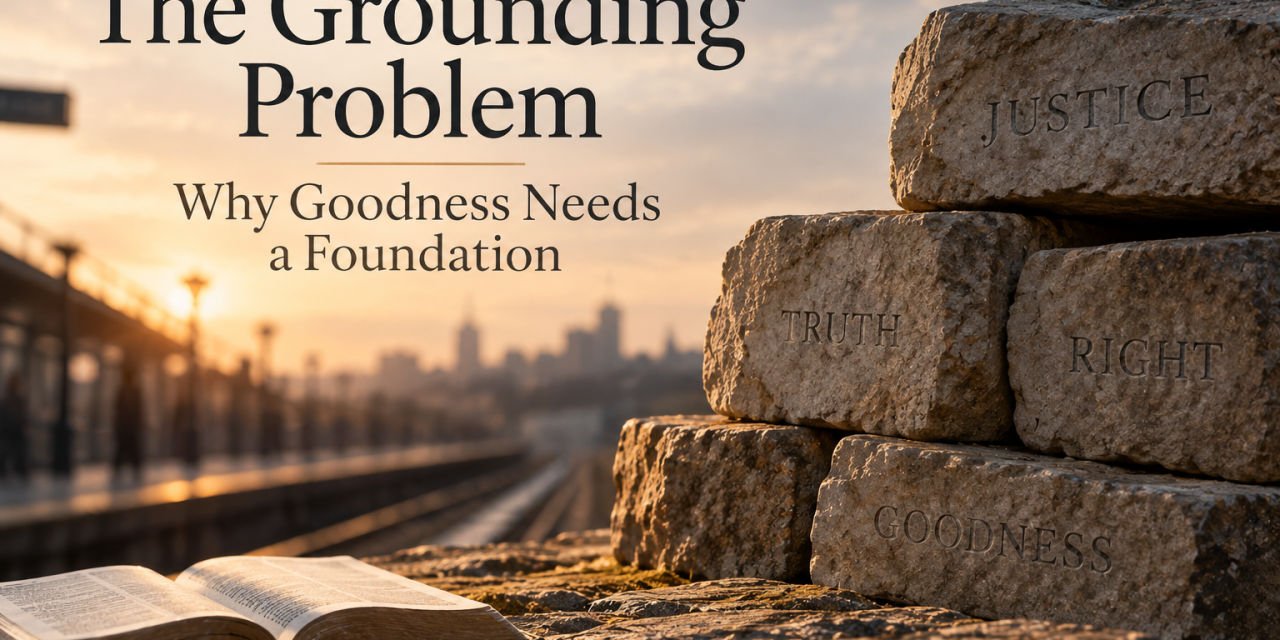
The Grounding Problem for Philosophy Students
It is easy enough to discuss ideas around a dinner table and suggest that right and wrong are simply social habits, rules we invented to keep society orderly, or instincts passed down through human history. But that intellectual comfort vanishes the moment we stand near a real victim.
If someone suffers a malicious betrayal, no one comforts them by whispering that harm is merely an illusion or a matter of cultural perspective. To look into the eyes of someone who has been deeply wronged and claim that their pain rests on nothing more than a shared opinion feels deeply inadequate. Almost like a second injury.
In the presence of genuine suffering and genuine courage, our instincts refuse to treat morality as a mere story we tell ourselves. We live, act, and bleed as though the wrongness of cruelty is as solid and unyielding as the ground beneath our feet.
For new students of philosophy, this creates a significant tension. We often accept morality as self-evident without questioning its origin. Yet, if morality is merely a byproduct of biological evolution or social convention, can we truly say that certain actions are fundamentally wrong? Or are they just socially unpopular?
This question strikes at the heart of how we understand reality and our place within it. It exposes the logical gap between having moral rules and explaining their authority.
Distinguishing Subjective Taste from Objective Fact
To see the difference, it helps to separate two kinds of claims we make every day. Some are preferences. I prefer tea to coffee, or I find modern art more interesting than classical portraiture. No one is right or wrong here. We are simply describing personal taste, and there is nothing to argue about.
Other claims are different in kind. Cruelty for its own sake is wrong. Torturing an innocent child for entertainment is not merely unfashionable or a matter of taste. We treat it as objectively, universally evil. Wrong in every culture, at every point in history, regardless of who agrees.
Philosophers call the first kind of claim subjective and the second kind objective. This distinction is vital. It asks whether there is such a thing as objective moral value, and if so, what makes it real?
This points to two separate questions that are easy to blur together. Moral epistemology asks how we come to know what is good. We might learn through conscience, upbringing, reason, or revelation. But moral ontology asks a more basic question. What actually makes something good, independent of whether anyone knows it or believes it?
A society could be entirely mistaken about a moral fact and it would still be a fact. The issue is not how people learn right from wrong. The issue is what, if anything, makes right and wrong real in the first place.
Can Morality Exist Without a Transcendent Source?
It has become fashionable to say that you do not need God to be a good person. On the surface, this sounds reasonable. In one sense it is true. Plenty of people with no religious belief at all live generous, honest, self-sacrificing lives.
But the claim quietly slides past a different question. The issue was never whether a person needs to believe in God in order to behave morally. The issue is whether morality itself, as a real, binding feature of the universe, needs God in order to exist at all.
If morality is merely a byproduct of biological evolution or social convention, can we truly say that certain actions are fundamentally wrong? Or are they just socially unpopular?
Suggesting that right and wrong are simply social habits creates a problem for objective value. If right and wrong are invented rules or social habits designed to maintain order, then cruelty is only wrong because it disrupts social cohesion. This reduces moral truth to utility. It makes morality contingent on human agreement.
Yet our visceral reaction to the blind man on the train platform suggests something stronger. We do not feel that the wrongness of the act depends on whether society agrees. We feel that the act is wrong in itself.
This tension between cultural relativism and universal moral intuition is central to the study of ethics. If we hold that moral facts exist independently of human opinion, we must ask what grounds them. What makes them real?
The Need for a Foundation
If morality is merely a byproduct of biological evolution or social convention, the authority of moral claims becomes difficult to sustain. We might explain why we act morally, but we cannot explain why we ought to. We can describe the instinct to help, but not the duty to do so.
For the believer, this line of inquiry explores whether our moral intuitions point toward a transcendent Creator. For the sceptic, it challenges the very foundation of human justice and accountability.
We must distinguish between subjective preferences and objective moral facts. We must differentiate between moral ontology and moral epistemology. We must identify the tension between cultural relativism and universal moral intuition. And we must recognise the core problem of grounding morality in a naturalistic worldview.
Understanding why moral facts require a transcendent source rather than just social agreement is not an abstract exercise. It supports the case for God by showing that objective goodness requires an objective ground. Without that foundation, morality risks becoming nothing more than a useful fiction or a biological accident.
With that understanding as our starting point, we can move deeper into the arguments that seek to explain this reality. We can explore how these philosophical foundations connect to the broader case for God.
Continue the Study
We have outlined the central tension: objective moral values appear to exist, yet naturalistic worldviews struggle to ground them. Understanding this grounding problem is the first step in exploring the Moral Argument for God.
If you are intersested in learning more regaring the Moral Argument for God, you might want to consider exploring the full course on Bible Study Themes to deepen your understanding of the Moral Argument and its significance for faith and reason.. This course takes you through the full logical structure of this argument. You will examine how philosophers distinguish between subjective and objective claims, analyse the ontological requirements for moral truth, and evaluate the implications for our understanding of reality.
If you are a philosophy student or a leader seeking to understand the metaphysical foundations of ethics, this study material is designed for you.