“But I trusted in thee, O LORD: I said, Thou art my God. My times are in thy hand.”
Psalm 31:14–15 (KJV)
Most of us like to feel that we have a handle on our lives. We make plans, keep diaries, set reminders and try to stay one step ahead of whatever might come next. And yet, if we are honest, so much of life is simply out of our hands. Health can change in a single appointment. A job can disappear in a single conversation. The people we love grow older, and so do we. The more we try to hold everything together, the more we discover how little we actually control.
Psalm 31 was written by a man who knew that feeling well. David was surrounded by trouble. He speaks of his life being “spent with grief” and his years “with sighing”. Enemies were plotting against him, and even his strength was failing. But in the middle of it all he says two remarkable things: “Thou art my God,” and “My times are in thy hand.”
Charles Haddon Spurgeon, the great Victorian preacher of London’s Metropolitan Tabernacle, preached a sermon on these very words. He preached it, by his own admission, while “full of pain” and with “a heavy headache”, and yet he could say, “thank God, I have no heartache, with such a glorious truth before me.” What follows are some of the riches he draws out of this one short verse.
What Are “My Times”?
Spurgeon explains that “my times” means all the changing seasons of a person’s life; in his words, “my ups and my downs, my health and my sickness, my poverty and my wealth.” Our circumstances shift constantly, but they shift only according to the purpose of the God who does not change. He also points out that the verse is personal. The congregation had just sung a hymn with the words “Our times are in thy hand,” and Spurgeon gently urged them to read it in the singular instead: “My times are in thy hand.” As he puts it, “truth is sweetest when each man tastes the flavour of it for himself.” It is one thing to believe that God governs the world. It is another to believe that He holds my life, my family, my tomorrow. And for the Christian, those hands are not distant or unknown. Spurgeon reminds his hearers that “my times are in those hands which were nailed to the cross for my redemption.” The hands that hold our future are the same hands that were pierced for our sins.
Not Chance, and Not Cold Fate
One of the most helpful parts of the sermon is the way Spurgeon rules out two common ideas about how life works.
The first is chance: the idea that things simply happen by luck, with no purpose behind them. Spurgeon will have none of it. Quoting Proverbs, “The lot is cast into the lap; but the whole disposing thereof is of the LORD,” he insists that “there is no place for chance, since God filleth all things.”
The second is fate: the grim idea of a vast machine grinding on without pity. Spurgeon answers that if we picture providence as a wheel, “it must be a wheel which is full of eyes.” Our comfort is not that our times are fixed in some cold, impersonal system, but that they are in the hand of a living, loving Father. In his words, our great joy is not “My times are in the wheel of destiny,” but “My times are in thy hand.”
Seven Ways This Truth Changes Us
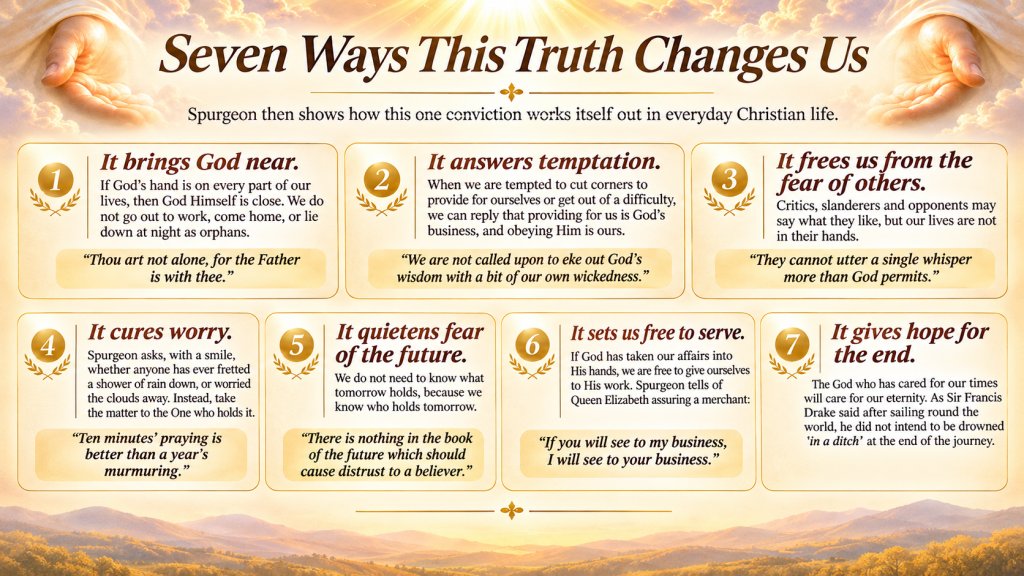
Spurgeon then shows how this one conviction works itself out in everyday Christian life
- It brings God near. If God’s hand is on every part of our lives, then God Himself is close. We do not go out to work, come home, or lie down at night as orphans. “Thou art not alone, for the Father is with thee.”
- It answers temptation. When we are tempted to cut corners to provide for ourselves or get out of a difficulty, we can reply that providing for us is God’s business, and obeying Him is ours. “We are not called upon to eke out God’s wisdom with a bit of our own wickedness.”
- It frees us from the fear of others. Critics, slanderers and opponents may say what they like, but our lives are not in their hands. “They cannot utter a single whisper more than God permits.”
- It cures worry. Spurgeon asks, with a smile, whether anyone has ever fretted a shower of rain down, or worried the clouds away. Instead, take the matter to the One who holds it: “Ten minutes’ praying is better than a year’s murmuring.”
- It quietens fear of the future. We do not need to know what tomorrow holds, because we know who holds tomorrow. “There is nothing in the book of the future which should cause distrust to a believer.”
- It sets us free to serve. If God has taken our affairs into His hands, we are free to give ourselves to His work. Spurgeon tells of Queen Elizabeth assuring a merchant, “If you will see to my business, I will see to your business.”
- It gives hope for the end. The God who has cared for our times will care for our eternity. As Sir Francis Drake said after sailing round the world, he did not intend to be drowned “in a ditch” at the end of the journey.
Worry, Prayer and the Man at the Wheel
Of all these points, the one about worry may speak most directly to many of us. Spurgeon notices that worry rarely achieves anything. It does not change the weather, pay the bills or fix the problem. What it does do is rob us of peace and cloud our judgement.
He uses a lovely picture from the steamboats of his day, which carried a notice: “Do not speak to the man at the wheel.” We are often tempted to argue with God about how He is steering our lives. But the Pilot knows the sea, and He knows exactly where we are, even when we do not.
This echoes the words of Jesus: “Take therefore no thought for the morrow: for the morrow shall take thought for the things of itself” (Matthew 6:34). And the apostle Peter: “Casting all your care upon him; for he careth for you” (1 Peter 5:7). To say “my times are in thy hand” is not to stop caring about our lives. It is to place that care where it belongs.
Spurgeon speaks from experience here. He describes times when the money for his orphanage and college ran very low, and he had nowhere to turn but to the Lord, and how the Lord met those needs again and again. He even says it became a joy to be driven to the place “where none but the Lord can help you, and then to see his mighty hand pulling you out of the net.”
A Word for Everyone
Near the end of the sermon, Spurgeon turns to individual people in his congregation: an elderly woman who had come from the workhouse that morning, a man who had walked “the shoes off [his] feet” looking for work, a sister wasting away with illness, and a young businessman who had just suffered a crushing loss. To each one he says the same thing: you too may say, “My times are in thy hand.”
But he is also honest that this comfort belongs to those who trust in God. To be in God’s hands as an unrepentant sinner is a frightening thing. Yet even here there is hope, for “his mercy endureth for ever.” Spurgeon closes by urging his hearers to flee to Christ Jesus, and then the same mighty hand that they once had reason to fear will become their comfort and their safety.
Taking It Home
Whatever season you are in today:- waiting, grieving, struggling, or simply busy- these five words are worth carrying with you. Spurgeon’s advice was simple: “Take the golden sentence home with you.” Let it sit on your tongue “like a wafer made with honey,” until your whole outlook is sweetened by it.
You may not know what the coming week, month or year will bring. But if you belong to Christ, you can know this: your times are not in the hands of chance, or fate, or other people. They are in the hands of your Father.
Listen to the sermon by Charles Spurgeon: My times are in thy hand.